Introduction
Consider three typical purchase decisions, that of, buying a new car for your family, a toiletry product for self use and a wedding gift for someone close to you. Each of these purchase decisions are of different nature, in terms of value proposition, involvement and risk you may perceive. The kind of product values, risks consumers perceive in each of these the buying situations are completely different. It is important for a marketer to understand these subtleties to be effective.
The Purchase Process
Consumers typically go through the below stages in the purchasing journey. 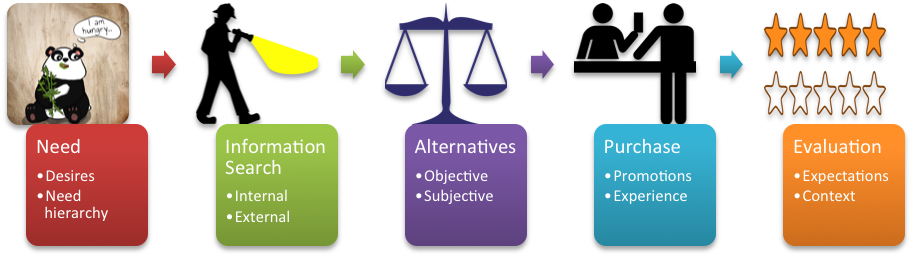
Need Recognition
This is the first and most important stage of the purchase process. This is where the consumer perceives a need for buying a product or service. The consumer perceives a need when there is a difference between their current situation and the desired situation. Hence it is important for a marketer to tailor the communication to highlight how their brand fills the gap between the current situation and the desired situation of the target customer. There are many need identification models available to the marketer, like Maslow’s Need Hierarchy. This model states that human needs can be classified as below.
- Physiological needs
- Safety needs
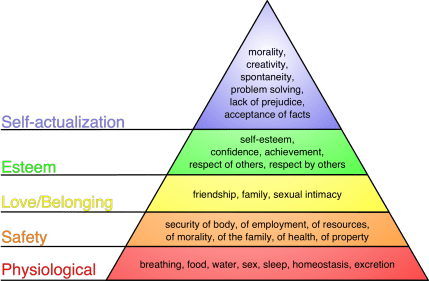
- Need of love and belonging
- Need of esteem (for oneself and from the others)
- Physiological needs
- Need of self-actualization
A person could be at any one level of the hierarchy and their needs will be according to the level they belong to. It is not necessary that a person must have satisfied all the needs at a level to go to the next level. The marketer needs to meticulously identify which of these needs does their target customer fit into before communicating.
Information Search
Once the consumer recognizes a need, he starts searching for solutions that can satisfy the need. The information could be internal or external. Internal is based on the experiences; whereas external is based on research, referrals, direct marketing communications and so on. It might appear that a marketing campaign can impact only external information, but through the implementation of appropriate learning techniques, a marketer can alter the internal information as well. For example, an advertisement played repeatedly may start to make sense to the customer eventually.
Evaluation of Alternatives
Once all the necessary information is available, the consumer compares and evaluates all the solutions available and zeroes in on one solution. Evaluation broadly has two components, in the form of objective and subjective attributes. For example, checking for the features of a car is objective, whereas having a brand preference is subjective.
Purchase
The activity of purchase is where the consumer buys the solution. This may depend on the factors like shopping experience itself, promotions available, return policy and so on.
Post Purchase Evaluation
Once the consumer purchases a solution, he will evaluate the purchase based on his expectations. His evaluation is often going to be subjective and context dependent. If he had low expectations, an average solution would make him extremely satisfied. However, a consumer with high expectation would be disappointed with even minor glitches.
Examples
Car For The Family
In the Indian context, a car is classified as a specialty consumer good. It is more of a luxury than a necessity. Hence when a consumer looks to buy a car, the aesthetics, creature comforts, perceived engine power, and brand value are important considerations. However, an average Indian family is value conscious and looks for factors like fuel economy, storage space, seating space, service quality and expenses, and resale value. Many families are also seen buying extended warranty plans and comprehensive insurance policies for their primary car. This is expected as the repair costs have dramatically gone up in the recent years and rates of minor accidents are extremely high, especially in the urban regions. More affluent/educated car buyers (enthusiasts) look at the technical specifications more closely and also factor in the handling characteristics of the car. These consumers often demand more test-drive time and better test-drive conditions. Car buyers in India perceive the possibility of accident and poor quality as significant risks. They mitigate these risks by buying extended warranty and comprehensive insurance at marginally higher prices.
Toiletry Product
Toiletries are classified as Fast Moving Consumer Goods. They are sold quickly and at low costs. Also, they are usually routine purchases. Because of this reason, if a brand stands out from the rest, there are higher chan ces of consumers giving its products a try. Also, consumers watch the advertising campaigns closely to understand the benefits of products clearly. Smell, taste, package appearance, color, perceived effect on beauty and/or hygiene are important considerations for a purchase. Also, the promotions can be a powerful tool to lure the consumers. Also, how the products are positioned matter a lot for the purchases. For example, Olay products were initially perceived to be for women older than 30 years of age. This was because the advertising campaigns famously highlighted how Olay products reduced the signs of aging, hinting the customers at they should use Olay to hide signs of aging. Later it was repositioned through advertisements that advised women to start using the products at a younger age so that they avoid signs of aging in the early 30s. These advertising techniques can successfully alter the customer perception, thus influencing the buying patterns.
Wedding Gift
A wedding gift is a token of good wishes and closeness expressed towards someone who is getting married. This should be looked at as the consumer’s way of symbolizing a relationship. The motivation for giving could be obligatory or voluntary in nature. It could also have a sense of symbolization of status attached with it. In such cases, money is less of an issue compared to the obligatory gestures. All kinds of gifts are sometimes reciprocal and/or ritual. Many gift givers expect an emotional response from the recipient; hence they look for gift items, which can trigger those emotions. The type of gift given also depends on personality and societal status of the giver and recipient. For example, sophisticated and high status consumers would expect and give symbolic gifts such as decorative items, latest gadgets and so on. The more practical consumers may go with more functional gift items such as kitchen appliances. Lately, those who are unsure of what to gift prefer to give gift vouchers so that the recipient can choose to buy what he wants with it.
 Thought Farming