Marketing is not a battle of products; it is a battle of perceptions.
Introduction
Consumers often act and react on the basis of their perceptions, rather than objective
reality. For example, many people in the world perceive that cold temperature of refrigerated milk indicates freshness. In fact, we interpret sensory stimuli with our own unique biases, knowledge and experiences. This article addresses how consumer perceptions are developed from prior knowledge, consumption culture and exposures with simple examples.
What Is Perception?
Perception is a process by which an individual selects, organizes, and interprets the stimuli into a meaningful and coherent picture of the world. In simple words, what a person sees as world is nothing but is a picture he is drawing in his mind based on his observations, intellect, past experiences and preferences.
Perception has a tremendous impact on the buying patterns of today’s consumer. Hence, it is important for any marketer to understand how it is formed in the minds of their consumers. Once you understand the dynamics of perceptions of your target market, you can hone your marketing communications suitably, to be perceived as a stronger brand in their minds. This mind share is highly required to stay competitive in today’s competitive markets.
How Is It formed?
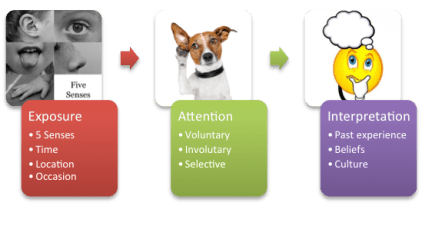 Perception can be viewed as a process in the brain, which helps in making sense of the surroundings. It is a roughly 3-staged process with Exposure, Attention and Interpretation stages.
Exposure
Perception is triggered by one of the five sensory organs in the form of visuals, sounds,
touch, smell and taste. This is called exposure. Exposure depends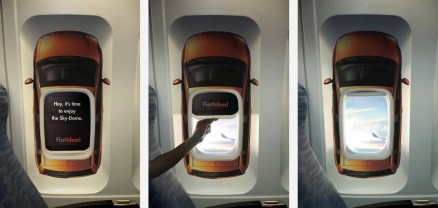 on time, location, occasion and other environmental factors too.
Once the sensory organ transmits the raw information to the brain, there are two major reactions that come about namely attention and interpretation.
Attention
The brain exhibits different attention behaviors while picking up the information received.
These behaviors can be classified into voluntary, selective and involuntary. Voluntary attention could be triggered from activities like training, education or competitions. Selective attention is when the consumer chooses to try a part of the whole experience than everything based on certain cognitive decisions and/or depending on the sensory bottlenecks (E.g. a value conscious car buyer scans the advertisement for clues about the fuel economy figures. His brain will instantly pick up any moment in the advertisement, which hints at that).
Involuntary exposure occurs when attention is diverted without any conscious effort of the consumer (E.g. Fiat’s clever embedded advertisement campaign for sunroof of Fiat 500). This is what is commonly known as catchy.
Interpretation
This is the most critical part of the perception process. This is where the consumer forms an image of the brand or product based on the communication received by him as well as the prejudice he has. In simple terms, a marketer needs to be very aware of the personality types of his target customers to be effective in drawing the right brand image in the minds of their customers. Based on the brand personality (Excitement/Sincerity/Ruggedness/Competence/Sophistication) that the marketer wants to picture and the demographics and psychographics of the target customer, the stimuli could be personally relevant, pleasant, easy to process or surprising.
Examples
Cadbury India – The Chocolaty Journey
When Cadbury UK first established their chocolate business in India circa 1948, they were importing their Diary Milk brand as it is and distributing to Indian consumers. The major challenge was that Indians perceived chocolate as an external flavor. Because of this perception, many people showed their resistance to adoption of Diary Milk. Indians at the time were generally more culturally inclined, and also they had just become independent after long durations of British rule. This might have escalated the situation further.
Cadbury India understood this challenge quickly and also recognized the importance of
convincing the buyers about the benefits rather than trying to lure the users. Indian families were hierarchical in nature and fathers made th e decisions more often than not. Hence Cadbury positioned the Diary Milk brand as a means for fathers to show affection towards their children. With time, this strategy worked wonders for them and improved the sales of Diary Milk.
Later when they had to find more market segments, they re-imaged the Diary Milk brand to showcase the brand to be relevant even for adults who like to be spontaneous and carefree. This again changed the perception in the minds of youth of ages 18 to 28 and drove the revenues higher. In both these repositioning efforts, Cadbury India managed to understand the consumer psyche and cultural barriers and address them.
Tata Nano – From Cheap Car To The Youth Car
 When Tata announced the Nano car, there was a misjudgment in the ripples it would create and the impact of the marketing communications. Ratan Tata came out in the open announcing that Tata was making the world’s cheapest car.
If we closely observe the target market for this car, we see that the consumers in this segment are self reliant, proud, socially sensitive people. No one with this background wants to be perceived to be driving a cheap car. They are
looking for value for money, but not just a cheap product. The “cheap” tag given by Tata’s marketing team as well as plethora of media coverage put off many customers. This was one of the prime reasons why Nano did not sell as widely as it was initially believed. The primary value this segment was looking for was an efficient, value for money, easy to drive, good-looking car. While Nano was all those, Tata’s marketing communication could not touch the target customers on those points.
Once Tata realized their mistake, they repositioned Nano as a youth centric brand with new series of advertisements and also showed the ease of driving that the car brings in. This new series of campaign has had a much better impact on the customers and the perception about Nano seems to be changing.
 Thought Farming